Book titles game, if you’re game.

shutterstock_114204907

Some of the most famous book titles almost never made it to print. Here’s a look at some classic novels and what they were going to be called.


George Orwell’s Nineteen Eighty-Four was originally titled The Last Man in Europe.

Harper Lee’s To Kill a Mockingbird was originally titled simply Atticus.

Jane Austen’s Pride and Prejudice was originally titled First Impressions.

Ernest Hemingway’s The Sun Also Rises was originally titled Fiesta.

Leo Tolstoy’s War and Peace was originally titled All’s Well That Ends Well.

William Golding’s Lord of the Flies was originally titled Strangers From Within.


After looking at these I decided to create my own list. (This is what happens when the television networks take my favourite shows off air, without any notice.)  I thought I’d have some fun and create a game with some truly awful alternative names to some famous books. See if you can guess which title belongs to which book. The answers are below just match the number with the letter. I’ll give you the answer to the first one to start .  1 – F

Have fun.


  1. Did he, or didn’t he do it?
  2. A Very Unusual Cake
  3. Here Piggy, Piggy
  4. Colour Coded People
  5. A Spoilt Girl Learns a Lesson- Almost
  6. Nerds Rule
  7. Marry My Daughters
  8. The Very Ordinary Nick Carraway


A. Charlottes Web, B. Gone With the Wind, C. Divergent, D. The Help, E. The Rosie Project, F. Gone Girl, G. The Great Gatsby, H. Pride And Prejudice
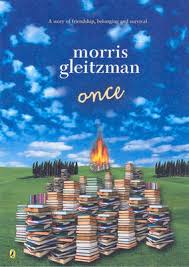
Once

once image

The book Once by Morris Gleitzman came to me by way of my son. He was given a copy for his 11th birthday and he said I could read it first because it was on my must –read list. The book is set in Nazi occupied Poland in 1942 and we follow the story of a young boy named Felix. We meet Felix at a catholic orphanage, which he had been living at for the past 3years and 8months. He and his parents are Jewish so they sent him there to keep him safe, although Felix believes he is there while his parents sort through a difficult time with their bookshop.

After witnessing Nazis’ burning books at the orphanage, Felix decides to leave the orphanage and find his parents to help them save their books. We journey with Felix as his childhood innocence slowly dissolves and his eyes are opened to the atrocity of the holocaust around him. This book grabs your heart and doesn’t let go. It squeezes and tugs at every page. It is relentless and exhaustive. I truly loved this book, but as my son is a sensitive 11year old he may need to wait a little longer to read such painful truths. There are three more books in the series After, Now and Then.
Once by Morris Gleitzmann
Once I escaped from an orphanage to find Mum and Dad.

Once I saved a girl called Zelda from a burning house.

Once I made a Nazi with toothache laugh.

My name is Felix.

This is my story.

Everybody deserves to have something good in their life.

At least once.

What’s in a name?

shutterstock_127361840

I was thinking about pen names the other day, as I about to embark on a new project and wondered whether I should use one of my pen names. I have a little cache of names I use when writing for newspapers, my reason being that I don’t want my fiction work associated with my journalistic work. My choice of names are pretty boring, I’m not doing the star checking into a hotel thing and saying I’m Katniss Everdeen or Mr. Darcy, I’m just initialising, middle name etc. Many famous writers have used Pseudonyms or pen names for many reasons.

The most annoying is for sexist or gender bias reasons.

The Bronte sisters, Charlotte, Emily and Anne, were first published as Currier, Ellis and Acton Bell, when the publishers finally met their writers they were shocked to see they were women. Louisa May Alcott, before writing Little Women, published stories under the name A M Barnard. We may excuse this by saying it was Victorian times, but as many are aware Joanne Rowling was asked to asexualize her name as the publishers believed a book about a boy wizard wouldn’t appeal to it’s audience if they knew it was written by a women. J.K Rowling also later went on to write The Cuckoos Calling as Robert Galbraith. Rowling states her reason being to “go back to the beginning of a writing career in this new genre to work without hype or expectation”

Some writers want to simplify their names.

Joseph Conrad was born Jozef Teodor Konrad Korzeniowski.

Lewis Carroll was born Charles Lutwidge Dodgson.

Mark Twain born Samuel Longhorne Clemens.

Some writers want to distance themselves from previous works.

Agatha Christie, being a successful suspense writer, used the pseudonym Mary Westcott to write 6 romance novels. In reverse Nora Roberts, the successful romance novelist wrote under the name JD Robb for her suspense novel series. The Booker Prize winners Julian Barnes and John Banville wrote crime /thriller novels under the names Dan Kavanagh and Benjamin Black.

The two, which I find the most amusing, are Benjamin Franklin who wrote for a newspaper under the name of Mrs. Silence Dogood. –He must have had a sense of humour. The second is Theodor Geisel; he was the editor of his universities newspaper until caught with alcohol during prohibition. To continue writing he invented a pseudonym. He took his middle name Seuss and to annoy his father, who wanted him to be a doctor, he added the title, hence the birth of Dr. Seuss.

I’ll leave you with a puzzle, who published early works under the name of Boz?

Is the beginning the end?

shutterstock_146694977

The start of a novel can make or break a book for me. It has to grab my attention with the very first line. As everyone today, I am too time poor to hang around hoping the book will get better. Am I too harsh? If an author has not put everything into their opening sentence then where is the respect to the reader? But here lies the problem, what makes a good first sentence? Every reader has different taste and I know what I like and if the writing is good,  I’ll stick around and give the book a fighting chance.

I recently attended a talk by the author Alexander McCall Smith. McCall Smith discussed the importance of a great opening line. He then delighted us with one of his favourites from The Tower of Trebizond by Rose Maccauly.

“Take my camel dear,” said my Aunt Dot, as she climbed down from this animal on her return from High Mass.

Has the reader curious. No?

My favourite is a little more subdued, from the master himself, Charles Dickens’ A Tale of Two Cities. Whenever I read this I wonder whether Dickens sweated over every word, rearranging, rewriting, putting in a comma and then removing it again or was he hit by inspiration and it flowed in one sitting. Here it is, for your pleasure.

“It was the best of times, it was the worst of times. It was the age of wisdom, it was the age of foolishness. It was the epoch of belief, it was the epoch of incredulity. It was the season of Light, it was the season of Darkness. It was the spring of hope, it was the winter of despair

My son wanted to add his favourite, it’s the opening line of J.R.R Tolkien’s The Hobbit

“In a hole in the ground there lived a Hobbit”

What is your favourite opening sentence?

A book is a book, or is it?

Boy with book

“Books let us into their souls and lay open to us the secrets of our own”.
-William Hazlitt

There was one book in my childhood, which shone brighter than all the others it was The Secret Garden by Frances Hodgson Burnett. I read this book over and over. My mother was the school librarian, and she would exclaim ‘again?’ when I’d place the book on her desk on library day. My mother probably thought my recurrent borrowing was because the library was very small, (actually almost non-existent – one wall of fiction) or because I did not own any books myself. The reason was that this book spoke to me like no other had before it. I believe that there is at least one book in a child’s life, which has such a profound impact that it stays with them for life. I can picture a generation of “Harry Potter” fans nodding their heads at this statement.
Mary Lennox, The Secret Garden’s protagonist, was with me when I was sad, happy or lost in a daydream. I suspect a little part of her creeps into my lead characters in every story I write. I believe we are drawn to someone we identify with or someone who embraces the qualities we wish we had. Mary was stubborn, and I’ve been called that once or twice, okay, I’ve been called that a lot, but she was also brave, tough and adventurous, all qualities I admired.
Let me know what book/character shaped your childhood.
“Where you tend a rose, my lad, a thistle cannot grow”- The Secret Garden