Liebster Award

liebster image

Yay! How exciting to have Bookgirl nominated for a Liebster award. Another blogger describe it as a “Virtual Hug”; I like that.

I wish to thank fellow blogger http://ejmcgrorey.wordpress.com for nominating me. You are wonderful! It ‘s is so nice to have people say I’ve read and liked what you’ve written.

The Liebster award is a way to spread the word about new blogs you love, so I’ve joined the list and I hope to share with you some fantastic blogs and some random facts about moi!

The Rules


If you have been nominated for The Liebster Award AND YOU CHOOSE TO ACCEPT IT, write a blog post about the Liebster award in which you:

1. thank the person who nominated you, and post a link to their blog on your blog.

2. display the award on your blog — by including it in your post and/or displaying it using a “widget” or a “gadget”. (Note that the best way to do this is to save the image to your own computer and then upload it to your blog post.)

3. answer 11 questions about yourself, which will be provided to you by the person who nominated you.

4. provide 11 random facts about yourself.

5. nominate 5 – 11 blogs that you feel deserve the award, who have a less than 1000 followers. (Note that you can always ask the blog owner this since not all blogs display a widget that lets the readers know this information!)

6. create a new list of questions for the blogger to answer.

7. list these rules in your post (You can copy and paste from here.) Once you have written and published it, you then have to:

8. Inform the people/blogs that you nominated that they have been nominated for the Liebster award and provide a link for them to your post so that they can learn about it (they might not have ever heard of it!)


The answers to the 11 question provided by 90,000 wordshttp://ejmcgrorey.wordpress.com/

  1. What are you hoping to achieve with your blog?

Meet, Entertain and Inform.

  1. What’s the best advice you’ve ever been given on blogging/writing?

Perseverance

  1. What was the last concert you went to?

Robbie Williams with the added support of Duran Duran -bonus!

  1. What’s your biggest dream?

That I was Buffy, slaying evil vampires – oh, you mean that type of dream.

I’m at the Academy Awards giving my much rehearsed acceptance speech for best screenplay.

  1. What’s the best TV show you’re currently watching and why?

I still love The Amazing Race. I would love to go on that show.

Except if they have a gross eating challenge then I’d have to hand that over to my partner.

  1. Why do you write?

I have a strange compulsion where my hand has its own free will and makes lots of scribbles on pieces of paper; it’s a condition really. No piece of paper can be left blank.

  1. When was the last time you wrote a letter and who was it to?

Yesterday. It was to my son’s teacher. This alone keeps stationary makers in business.

  1. On the weekend, if you’re not writing, what are you usually doing?

This is allocated family time. I’m all theirs.

9. Coke or Pepsi?

Neither, they are both evil conglomerates haha.

10. If you could go anywhere in the world tomorrow, where would you go and why?

Harry Potter world, I have a few spells I’d like to cast.

11. How would you describe yourself in three words?

I am stubborn.

Next 11 Random facts: Hmmm if you go to my about page I’ve already shared 7 so therefore i owe  only 4.

1. My eyes are sometimes blue, sometimes green.

2. I find the reality shows “The Housewives of… ” a fascinating anthropological study.

3. I’m obsessed with the traffic report.

4.  I’m a girl who hates shoe shopping.

Five blog I nominate are:

http://forgottenmeadows.wordpress.com

I love this blog because she post beautiful poetry that brings sunshine to my day.

Welcome to the Online Home of Rhonda Blackhurst, Author, Indie Author Consultant, and Certified Life Coach

I nominate this blog because her words come from the heart and i always appreciate what she has to say.

http://catamesbury.wordpress.com

Cat is a talented and generous writer and her posts are always a highlight of my week.

http://fictionfanblog.wordpress.com

Love FictionFans blog, excellent reviews with entertaining writing and pics as well.

http://lakmi.wordpress.com

I nominate Lakmi for her meaningful words, that are both touching and beautiful.

My eleven questions I ask these bloggers are:

1. Name the superhero power you would most like to possess.

2.Which author, alive or dead, would you like to meet?

3. What book was your favourite as a child?

4. Which book do you wish you wrote?

5. Have you always wanted to be a writer?

6. If you had to choose another occupation what would you be?

7. What’s your favourite genre?

8. What was the worst book to film conversion?

9. What was the best book to film conversion?

10. Why did you start blogging?

11. Have you enjoyed the blogging experience?
 

In Memory of Maya Angelou

I was saddened to hear the passing of one of my favourite poets today, Maya Angelou. In memory of her, I wish to share one of her poems that I love.

Pretty women wonder where my secret lies.
I’m not cute or built to suit a fashion model’s size
But when I start to tell them,
They think I’m telling lies.
I say,
It’s in the reach of my arms
The span of my hips,
The stride of my step,
The curl of my lips.
I’m a woman
Phenomenally.
Phenomenal woman,
That’s me.

I walk into a room
Just as cool as you please,
And to a man,
The fellows stand or
Fall down on their knees.
Then they swarm around me,
A hive of honey bees.
I say,
It’s the fire in my eyes,
And the flash of my teeth,
The swing in my waist,
And the joy in my feet.
I’m a woman
Phenomenally.
Phenomenal woman,
That’s me.

Men themselves have wondered
What they see in me.
They try so much
But they can’t touch
My inner mystery.
When I try to show them
They say they still can’t see.
I say,
It’s in the arch of my back,
The sun of my smile,
The ride of my breasts,
The grace of my style.
I’m a woman

Phenomenally.
Phenomenal woman,
That’s me.

Now you understand
Just why my head’s not bowed.
I don’t shout or jump about
Or have to talk real loud.
When you see me passing
It ought to make you proud.
I say,
It’s in the click of my heels,
The bend of my hair,
the palm of my hand,
The need of my care,
‘Cause I’m a woman
Phenomenally.
Phenomenal woman,
That’s me.
Maya Angelou

THE Agatha Christie Mystery

newspaper 1index

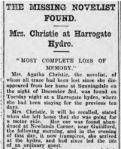
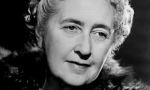
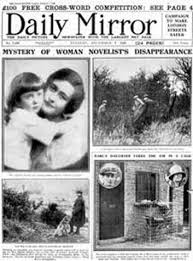
This post is a little bit of fun. There are so many interesting author stories out there I thought I’d delve into the 11 day disappearance of crime novelist, Agatha Christie. For those of you haven’t heard this before I hope you find it as intriguing as I do and for those of you who have heard it then –sorry.

It was a cold December night in 1926 when Agatha Christie kissed her daughter goodnight and stated she was going for a drive in her Morris Cowley. The following morning the car was found abandoned, by a lake with the hood up, inside, were her fur coat and a small suitcase.

Mrs Christie’s disappearance became the hot topic around dinner tables, bus stops and even parliament. Theories where coming left and right, some pointed to foul play at the hands of her unfaithful husband others at publicity stunt. If it happened to a crime writer today I would definitely say publicity.

Her disappearance had fellow writers Sir Arthur Conan Doyle (Sherlock Holmes) and Dorothy L. Sayers (Lord Peter Wimsey) on the hunt. Sir Conan Doyle even consulting a psychic. 15,00 volunteers and 500 police scoured the land, waterways and searched by air.


Mrs Christie was found 11 days later, at a spa Hotel in Harrogate, when a musician at the hotel recognized her. She had been staying there under an assumed name (more on this in a minute) since the day after her disappearance. This created more speculation as Mrs Christie claimed she had lost her memory. This may be the case, as she was under a lot of stress at the time. Her mother had recently died and her husband was leaving her for his mistress. Prior to the night of her disappearance Agatha had told friends that she was going to take a break in Yorkshire (which happens to be where the Hydropathic Hotel is located). On the night of her disappearance though Archie Christie (Agatha’s husband) had already left to go to a friend’s house to meet up with his mistress miss Nancy Neele. This is the curious part, the name Agatha used to check into the hotel was Teresa Neele.

Doctors diagnosed amnesia, but journalists (suspicious bunch they are) and police weren’t convinced. Mrs Christie had plenty of money on her person and it appears to be a highly unlikely coincidence that she would choose to register under her husband’s mistress’ last name.

Over the years expert have come forward claiming, evidence of a nervous breakdown and a stress induced condition known as “Fugue “ state (stress amnesia) in 1999 author Jared Cade interviewed Agatha’s brother- in –law who pronounced that Agatha created the hoax to spite her adulterous husband Archie.

Whatever the real reason she sure created a stir. The today the Hydropathic Hotel in Harrogate is known as The Old Swan and is now the fitting meeting place for the annual crime writing festival.


Another Night, Another Day

Another day another night

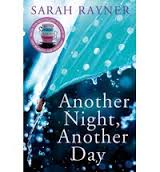
Another Night, Another Day is the new novel  by Sarah Rayner bestselling author of One Momnet, One Morning. The novel introduces us to the lives of three main characters; we follow their separate stories until they converge at a pivotal point. We see the effect mental illness has on them and their families, eventually bringing them together at the same treatment centre. Their lives are all different, as are their circumstances, yet they all need help.

What I enjoyed about Sarah Rayner’s book is how she handled this subject authentically. The characters are anyone and everyone. She demystifies mental illness and brings to light how it affects ordinary people living ordinary lives. She successfully strips away the fear that is often associated with mental illness. Rayner does not dwell on the tragedy, but explores the hope that understanding and support can bring.

This was a personal subject for me, and I have also written a short story on manic depression. Mental Illness is a large umbrella term, which I feel Rayner has opened out and let the reader see its many different facets.

Some of the characters in this book are being revisited from Sarah Rayner’s other books One Moment, One Morning and The Two Week Wait. I have not read either of these books and found Another Night, Another Day can standalone.

The official publication date for this book is 17 July, but Waterstones has it available to coincide with Mental Health Awareness Week.

This review was based on a publisher’s copy in exchange for an honest review. This, in no way, has influenced the review.

Publisher : Picador

Book Cover Design 101

shutterstock_173113388

Author: “Make my cover look like a bestseller”

Designer: “ No problem how’s this?”

If only it was that easy.

How do you choose a book? This question has been poised numerous times and the most common answer is “by its cover”. The cover design of a book has always had an important role in it’s marketing, and choosing the design is a complex process. With a growing number of authors self – publishing, understanding the psychology behind this choice is crucial.

Unfortunately in traditional publishing an author’s opinion isn’t always listened to, especially if the vision for their book does not match the publishers marketing strategy. There have been cases of authors leaving publishing houses due to disagreements on the cover art. This rang true to me recently when another blogger recommended the book Selection by Keira Cass; I had previously dismissed this series solely because the cover art projected an image that was ‘girly’ and ‘prissy’. I have now read the book and feel the cover has done the book an injustice.

In the traditional publishing world, there are whole departments devoted to cover design. The publishing houses give a brief to a designer, which usually stipulates that the design should articulate the contents of the book. You’d think this was obvious, but a book might be more suited to a more conceptual design.

A self- published author can be left in a quandary as in how to approach this subject. Authors can emulate the process that the publishing house use, but the main thing is to take time and consider carefully, what you want, as it is your brand.

Some suggestion to get you thinking:


  1. What is the image/feel you wish to project? E.g. A “Literary” novel cover is often understated, serious and elegant, withy heavy weighted paper and considered fonts.
  2. Decide on your budget. Can you afford to hire a graphic artist? If you have a large budget then Chip Kidd is the designer you want, probably no.1 in book cover designs at the moment. Have a look at his gallery www.chipkidd.com/gallery If you have a small budget approach some design schools and see if a students work catches your eye and negotiate with them.
  3. Look at current trends I personally do not like this. Remember when “Twilight” became a phenomenal success and every book following had a black cover with a single image.
  4. Do some market research, get a group of beta readers and have them read your book and give feed back on a selection of cover designs.
  5. Research psychology of colour and the emotions it creates.
  6. Research graphic/art techniques. For example the eye is drawn firstly to the top left hand corner of an image and then moves in a clockwise direction. This might affect your placement of images.
  7. Look up The Golden Mean/ Fibonacci Sequence used by artists for centuries. Many advertisers also use this technique.


If anyone has some suggestion on cover design please share.

The Ocean at the End of the Lane

ocean end of lane

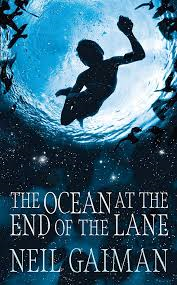
Neil Gaiman is mostly known for his wonderfully dark, Stephen Kingesq children’s novels, but he does dip his quill into the realm of adult fiction and it’s just as atmospheric and haunting. In his current novel, The Ocean at the End of the Lane, he delves into an adults’ recollection of his childhood. The narrator is a seven year old boy whose name we never learn, while reading the book I didn’t notice the absence of a name, it wasn’t until I finished that I went looking; maybe I missed it. Obviously this was deliberate and I wondered whether Gaiman was either trying to say it was insignificant or, more likely, that the character was unsure who he was.

Through a magically symbolic story, Gaiman explores how our memories of our childhood are perceived differently as an adult and how we are affected by them. The blend of fantasy and realism had me wondering if the boy’s imagination created an unreal world so he could deal with the real problems of his father’s infidelity and a family where he didn’t quite fit.

What I enjoyed most about this novel was Gaiman’s attention to the details of a child’s relationship and observations to the world around him and his interactions with his family. This excerpt shows his ability to capture a world through a child’s eye:

“Adults follow paths. Children explore. Adults are content to walk the same way, hundreds of times or thousands; perhaps it never occurs to adults to step off the paths, to creep beneath rhododendrons, to find the spaces between fences”

Plot, Plotter, Plotted

shutterstock_66243364

What is the plot of a novel? According to the Macquarie Concise Dictionary the word Plot means:

  1. A secret plan or scheme to accomplish some purpose, esp. a hostile unlawful, or evil purpose. (oooh)
  2. The plan, scheme, or main story of a play, novel, poem, or the like. (I like no.1 better)

The plot is the synopsis you send to the publisher, it’s the blurb on the back of the book that makes you spend your hard earned cash. So, how do you create an award winning, unique plot? If you research the subject you will find countless theories and analogies on the number of possible plot themes from “The seven basic plots”, “Twenty Master plots” and of course the famous “The Thirty-six Dramatic Situations”.

Are these lists any use to the writer? or do they interfere with the creative process and develop fiction devoid of imagination. I believe they have a place in the writing process. For example, my writing starts with an inspiration, an idea, I then develop the characters that can move this idea along and get the story to its conclusion. I’ll start with the beginning and/or end and then flesh out the ups and down of the middle. If inspiration isn’t coming easily there are many exercises writers use to get a basic plot going, but if the task ahead is Herculean and you are a prolific Trollopian writer a list of themes can be a godsend. I have a series, which centres on the same characters, and at times I look to this list for the spark to get a new theme started.

In the interest in serving my fellow writer I have included the 36 plot themes here. These themes were included in the above mentioned book in the 19th century, by French writer Georges Polti, then translated to English in 1916, but the list is credited to Goethe, who credits them to Gozzi from the mid 1700’s.


  1. Supplication
  2. Deliverance
  3. Vengeance of a crime
  4. Vengeance taken for kindred upon kindred
  5. Pursuit
  6. Disaster
  7. Falling prey to cruelty or misfortune
  8. Revolt
  9. Daring enterprise
  10. Abduction
  11. Enigma
  12. Obtaining
  13. Enmity of kinsmen
  14. Rivalry of kinsmen
  15. Murderous adultery
  16. Madness
  17. Fatal imprudence
  18. Involuntary crimes of love
  19. Slaying of a kinsmen unrecognized
  20. Self-sacrificing for an ideal
  21. Self-sacrifice for kindred
  22. All sacrificed for a passion
  23. Necessity of sacrificing loved ones
  24. Rivalry of superior and inferior
  25. Adultery
  26. Crimes of love
  27. Discovery of the dishonor of a loved one
  28. Obstacles to love
  29. An enemy loved
  30. Ambition
  31. Conflict with a god
  32. Mistaken jealousy
  33. Erroneous judgment
  34. Remorse
  35. Recovery of a lost one
  36. Loss of loved ones

If the dreaded writers block is firmly wedged, I hope this list will be the jackhammer of inspiration –Happy writing.


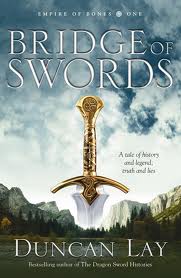
Bridge of Swords

bridge of swords

Sometimes the name of the leading character in a novel can make all the difference to me –I mean how great is the name Katniss Everdeen? I had one of those ‘name moments’ while reading Bridge of Swords by Duncan Lay. The protagonists name is Sendatsu, his name will not leave my thoughts, I keep saying it over and over again, I try to sleep and his name pops into my mind Sendatsu, Sendatsu! Lay has obviously created a memorable character. Its not just names that makes this fantasy novel memorable, Bridge of Swords is the first in the Empire of Bones trilogy, and it is an epic novel with a tale to tell.

Sendatsu is an elf, who passes through a protective barrier that shields the Elfan world from the human world; he was forced into the unfamiliar world to find the answer to the loss of Elfan magic. Sendatsu becomes involved with two humans named Huw and Rhiannon, these two characters provide the novels subplot. Wars are being fought in the human world and no matter how hard Sandatsu tries to stay uninvolved his warrior skills come to the aid of many and his involvement is set.

The plot and subplot explore the themes of power, greed, family and love. The themes are gently woven between the beautiful, cultural, Japanese like Elfan world to the raw, gritty, rough, medieval human world. Duncan Lay is a talented and skilled writer who manages to bring scenes to life. His action scenes are the breath holding, edge of your seat type, that have you page turning for more.

I have some catching up to do as the third book in the series was recently released, but am looking forward to see how the story unfolds.

Valley of Shields (Book 2 Empire of Bones)

Wall of Spears (Book 3 Empire of Bones)

Five books all writers should own


Every writer needs his arsenal of writing weaponry. After the obvious hardware such as pen, paper, computer, (duh!)the most useful purchase is a selection of helpful books. You’ve bought the dictionary and thesaurus (I hope), and if you’re a fantasy writer you may have bought a Lexicon of Myths and Fairytales or a crime writer may have bought a book on criminal investigation procedures, but what other books can help the aspiring writer. I’ve listed my top five and maybe some of you can share books or websites you’ve found helpful.

1.Elements of Style – William Strunk and E.B White

One piece of advice I remember from my studies of journalism at university was never leave home without this book.It is, by far, the best book written on grammar. Every journalist has it in their briefcase/ backpack because it contains wonderful little grammatical reminders that may have slipped our minds. (Unfortunately, the older I get, the more my mind slips)

2. On Writing – Stephen King 

I’m sure most writers have stumbled upon this book. Stephen King’s advice is straight up, no fancy pants talk. He just tells it like it is. I found this book to be practical and inspiring. When I’m feeling out of my depths I like to pick it up and have a flick, I always find something motivational. Here are some of my favourite quotes:


“The scariest moment is always just before you start.”

“Kill your darlings, kill your darlings, even when it breaks your egocentric little scribbler’s heart, kill your darlings.”

 “Your job isn’t to find these ideas but to recognize them when they show up.”

 “Words create sentences; sentences create paragraphs; sometimes paragraphs quicken and begin to breathe.”


  1. The Australian Writer’s marketplace

When I graduated from University this was my first purchase. It’s a compendium for writers listing details for submission and contact details for agents, magazines and newspapers, competitions and events, organisations, writers’ services, scripts and courses. My copy was heavily dog-eared, and I purchased many revised editions. This is centred on Australia, but a website that contains a fabulous array of publishing opportunities, for mainly the USA, is: http://www.everywritersresource.com/lists.html


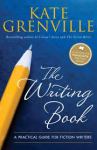
  1. The Writing Book –Kate Grenville

This is a practical guide, using exercises, to get the writer started and heading in the right direction. It contains practical advice on character development, plotting, writing dialogue. I found Grenville’s book to be the best in this genre, but I also like Holly Lisle’s online courses “How to Think Sideways”


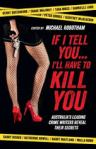
  1. If I Tell you I’ll Have to Kill you – Edited By Ian Robotham

This book is a recent addition to my collection and I’ve just finished reading it, so I thought I’d add it to the list. It is a collection of discussions from some of Australia’s best crime writers. Each writer explains, their writing process and the ins and outs of crime writing and how they came to be a writer. It is interesting (and often humorous) to read the various ways that writers go about their work, some are plotters and some are ‘go with the flow’ writers. This is a good read for all, not just those interested in the crime genre.