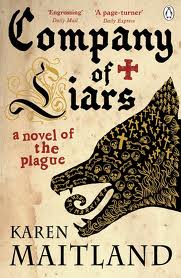
The Company Of Liars

Company of Liars


How I came to possess this book was one of those surreal moments. I stood in the secondhand bookstore amongst the dusty shelves and tattered books, my eyes were glazing over, inundated with choice, but seeing nothing. I ran my hand along the binds until it stopped at one book jutting out amongst the nondescript tomes. I turned the book over and read the many encouraging reviews from, surprisingly, reputable sources.

“An infectious tale of medieval intrigue” -The Herald

“A ghostly yarn…. A richly evocative page-turner” – Daily Express

Finding this book was pure serendipity. It was published in 2006. How did those eight years pass and I did not hear of this novel? I’m not going to go through the whole story, but I will give you the dust-jacket blurb as it says it best.

Blurb

  • A scarred trader in holy relics  A conjurer. A musician and his apprentice. A one-armed storyteller. A young couple on the run. A midwife. And a rune-reading girl. A group of misfits bands together to escape the plague. But in their midst lurks a curse darker and more malign than the pestilence they flee.

The backdrop is England in the midst of the black-death plague, but it is the minor stimulus that brings our nine main characters together. These characters have so much life they are running off the page sitting in my lounge room having a cuppa and conversation; they are that vivid. The story is richly matted with medieval historical facts and the supernatural. Maitland blends these elements so seamlessly that you start to question the history of medieval superstition and wondering whether magic may have truly been afoot.

If you have not read this book go out and buy it now, NOW!!

Company of Liars By Karen Maitland

Publisher: Penguin
 

Writing Just for Money

shutterstock_91902383

What will you write for money? Are you purist and only write for art sake? Or do you sell your soul and write for Penthouse?

When faced with bills I’ve looked under every crevice and nook for writing possibilities. I once tried to sell an article on Pere Lachaise (a famous cemetery in Paris) to an onboard airline magazine. I should have framed the response letter. It went something like this “we are sorry, but your subject matter isn’t exactly the what people like to read while flying in a tin can thousand of miles in the air” not my finest moment.

I’ve written about castles in Scotland, Monument valley in the USA, pink polka dot dresses, three legged dogs to triumph against adversity. I’ve written about talking pigeons, Interior colours, bell- bottom pants, and manic depression. The problem is making a living, as a writer is hard, it pays diddly squat. Not to undermine visual artists out there, but I’ve seen artists paint a painting in a day, then sell it for thirty thousand US dollars. I’ve seen a writer struggle for two years on a novel and given a five thousand dollar advance. (Side note, I do know plenty of struggling visual artists, I was just using the example for effect, sorry for any offence)

I wish I could say I only write when I feel the artistic tug, but the practicality is most of us have to force our words out, some for a looming deadline others for a daily word limit for their novels. The thing is, we do it regardless.

Why do we do it? Answer- passion.


Independent Novels

Today I’m reviewing two independent novels at request from the authors. I think it’s important to encourage and support this industry, but I will only give a fair evaluation and will not promote any writing that I feel is of poor quality. That said I was very happy to read and recommend both of these books, which are available at a very reasonable price on Amazon.


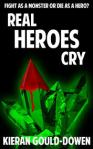
Real Heroes Cry by Kieran Gould-Dowen

Amazon Blurb:

How would you react if you had superpowers forced upon you? More importantly, who decides if that reaction is good or evil?

Standing in a deserted field in rural Hereford, Dom watches alongside his brother Elliot and best friend Zara as meteors crash from the sky. Thrown into the destruction and to his death by Elliot, Dom awakens not just alive but reborn. Confused by his new superpowers, in particular the power over all matter, he soon gets labelled a super villain and sent on the run. With both his evil brother playing the role of superhero perfectly and the new mysterious organisation GEU hunting him and Zara down for crimes Dom was framed for, he is forced to make a choice: die an unknown hero or play the monster to protect those he loves.
Leading his new family of “ghosts” and fighting for the girl he loves, this is a story you won’t just fall in love with, but you will become obsessed with. Forget everything you know about superhero stories, it is time to see how a real hero lives.

Review:

The beginning of the novel is a little disjointed and confusing, but once the main characters of Dom and Zara are introduced it settles into a smooth rhythm that evolves into an engrossing novel. There is strong character arc development as we see the protagonist, Dom develop from a carefree teenager into a leader. I was enthralled by this novel and found its plot gripping; in a X-men meets The Fantastic Four sense. The book sits firmly in it’s YA genre and I look forward to the future novels in this series.


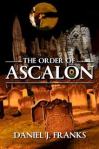
Order of Ascalon by Daniel J. Franks

Amazon Blurb:

A magical mystery adventure that takes you around the world…
After a group of drunken yobs mug sixteen-year-old Peter Butler one evening, he discovers that he has ancient magical powers, which will change the course of his life. Powers that will embroil him in the oldest conflict in human history, fought by influential and deadly secret organisations. Embarking on a daring magical adventure around the world, deciphering clues that lead him to long lost and powerful artefacts, hidden in famous landmarks, the Illuminati hunt him. The Arcanium need him. Governments want him!

Review:

Daniel J. Franks delivers a fantasy novel that catapults the reader head on into the world of intrigue, magic and adventure. Even the most reluctant reader would enjoy the fast paced rollercoaster ride that Franks takes to the reader. The writing is succinct and taut and the pace is reminiscent of a Matthew Riley novel. This is a light- hearted adventure that I recommend for the demographic of pre to early teens. This is the first book in the series and I’m sure it will develop a strong fan base.

Answers to Book Titles Game

In the previous post I posted a book title game where I changed some well known novel titles with some truly awful alternatives and readers had to match the titles. Thankyou everyone for your patience in waiting for the answers as I took a little break over Easter.

The much anticipated answers are:

  1.  Did he, or didn’t he do it? – F. Gone Girl
  2.  A Very Unusual Cake – D. The Help
  3.  Here Piggy, Piggy – A. Charlotte’s Web
  4. Colour Coded People – C. Divergent
  5. A Spoilt Girl Learns a Lesson -Almost – B. Gone With the Wind
  6. Nerds Rule –  E. The Rosie Project
  7. Marry My Daughters – H. Pride and Prejudice
  8. The Very Ordinary Nick Carraway -G.  The Great Gatsby

Hope you had fun and maybe this has inspired you to take a look at some books you may not have previously.


Book titles game, if you’re game.

shutterstock_114204907

Some of the most famous book titles almost never made it to print. Here’s a look at some classic novels and what they were going to be called.


George Orwell’s Nineteen Eighty-Four was originally titled The Last Man in Europe.

Harper Lee’s To Kill a Mockingbird was originally titled simply Atticus.

Jane Austen’s Pride and Prejudice was originally titled First Impressions.

Ernest Hemingway’s The Sun Also Rises was originally titled Fiesta.

Leo Tolstoy’s War and Peace was originally titled All’s Well That Ends Well.

William Golding’s Lord of the Flies was originally titled Strangers From Within.


After looking at these I decided to create my own list. (This is what happens when the television networks take my favourite shows off air, without any notice.)  I thought I’d have some fun and create a game with some truly awful alternative names to some famous books. See if you can guess which title belongs to which book. The answers are below just match the number with the letter. I’ll give you the answer to the first one to start .  1 – F

Have fun.


  1. Did he, or didn’t he do it?
  2. A Very Unusual Cake
  3. Here Piggy, Piggy
  4. Colour Coded People
  5. A Spoilt Girl Learns a Lesson- Almost
  6. Nerds Rule
  7. Marry My Daughters
  8. The Very Ordinary Nick Carraway


A. Charlottes Web, B. Gone With the Wind, C. Divergent, D. The Help, E. The Rosie Project, F. Gone Girl, G. The Great Gatsby, H. Pride And Prejudice

Once

once image

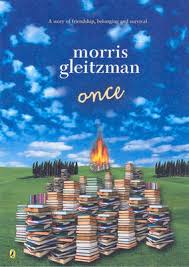
The book Once by Morris Gleitzman came to me by way of my son. He was given a copy for his 11th birthday and he said I could read it first because it was on my must –read list. The book is set in Nazi occupied Poland in 1942 and we follow the story of a young boy named Felix. We meet Felix at a catholic orphanage, which he had been living at for the past 3years and 8months. He and his parents are Jewish so they sent him there to keep him safe, although Felix believes he is there while his parents sort through a difficult time with their bookshop.

After witnessing Nazis’ burning books at the orphanage, Felix decides to leave the orphanage and find his parents to help them save their books. We journey with Felix as his childhood innocence slowly dissolves and his eyes are opened to the atrocity of the holocaust around him. This book grabs your heart and doesn’t let go. It squeezes and tugs at every page. It is relentless and exhaustive. I truly loved this book, but as my son is a sensitive 11year old he may need to wait a little longer to read such painful truths. There are three more books in the series After, Now and Then.
Once by Morris Gleitzmann
Once I escaped from an orphanage to find Mum and Dad.

Once I saved a girl called Zelda from a burning house.

Once I made a Nazi with toothache laugh.

My name is Felix.

This is my story.

Everybody deserves to have something good in their life.

At least once.

What’s in a name?

shutterstock_127361840

I was thinking about pen names the other day, as I about to embark on a new project and wondered whether I should use one of my pen names. I have a little cache of names I use when writing for newspapers, my reason being that I don’t want my fiction work associated with my journalistic work. My choice of names are pretty boring, I’m not doing the star checking into a hotel thing and saying I’m Katniss Everdeen or Mr. Darcy, I’m just initialising, middle name etc. Many famous writers have used Pseudonyms or pen names for many reasons.

The most annoying is for sexist or gender bias reasons.

The Bronte sisters, Charlotte, Emily and Anne, were first published as Currier, Ellis and Acton Bell, when the publishers finally met their writers they were shocked to see they were women. Louisa May Alcott, before writing Little Women, published stories under the name A M Barnard. We may excuse this by saying it was Victorian times, but as many are aware Joanne Rowling was asked to asexualize her name as the publishers believed a book about a boy wizard wouldn’t appeal to it’s audience if they knew it was written by a women. J.K Rowling also later went on to write The Cuckoos Calling as Robert Galbraith. Rowling states her reason being to “go back to the beginning of a writing career in this new genre to work without hype or expectation”

Some writers want to simplify their names.

Joseph Conrad was born Jozef Teodor Konrad Korzeniowski.

Lewis Carroll was born Charles Lutwidge Dodgson.

Mark Twain born Samuel Longhorne Clemens.

Some writers want to distance themselves from previous works.

Agatha Christie, being a successful suspense writer, used the pseudonym Mary Westcott to write 6 romance novels. In reverse Nora Roberts, the successful romance novelist wrote under the name JD Robb for her suspense novel series. The Booker Prize winners Julian Barnes and John Banville wrote crime /thriller novels under the names Dan Kavanagh and Benjamin Black.

The two, which I find the most amusing, are Benjamin Franklin who wrote for a newspaper under the name of Mrs. Silence Dogood. –He must have had a sense of humour. The second is Theodor Geisel; he was the editor of his universities newspaper until caught with alcohol during prohibition. To continue writing he invented a pseudonym. He took his middle name Seuss and to annoy his father, who wanted him to be a doctor, he added the title, hence the birth of Dr. Seuss.

I’ll leave you with a puzzle, who published early works under the name of Boz?

The Maze Runner

maze runner image

With the release of the movie and the box set of James Dashner’s series, I thought now was a good time to review The Maze Runner.
This is another novel set in a post apocalyptic world i.e. Hunger games, Divergent, The Forest of Hands and Teeth etc.
So how does it fare with the onslaught? Quite well.
Our Protagonist. Thomas wakes in a boxlike lift with no memory, in a place called the Glade. Living in the Glade are boys who arrived the same way over the past two years. The Glade is surrounded by a maze, which the boys believe holds the answer to getting home.
The atmosphere is reminiscent of Lord of the Flies, where hierarchies among the boys are developed and leaders are established. As the boys enter the ever-changing maze the themes of trust, loyalty and bravery are brought to the forefront.
Thomas shows himself to be a natural leader, but this is thrown into turmoil when a girl Teresa enters the maze and memories start to surface.
What Dashner does well is create tension and suspense. The reader is kept guessing, Where are they? What is this place? What is its purpose? Who controls the maze? Eventually, these questions are answered in the subsequent books. But I did not find the answers satisfying. I enjoyed The Maze Runner, but the other books left me flat and disappointed.

Is the beginning the end?

shutterstock_146694977

The start of a novel can make or break a book for me. It has to grab my attention with the very first line. As everyone today, I am too time poor to hang around hoping the book will get better. Am I too harsh? If an author has not put everything into their opening sentence then where is the respect to the reader? But here lies the problem, what makes a good first sentence? Every reader has different taste and I know what I like and if the writing is good,  I’ll stick around and give the book a fighting chance.

I recently attended a talk by the author Alexander McCall Smith. McCall Smith discussed the importance of a great opening line. He then delighted us with one of his favourites from The Tower of Trebizond by Rose Maccauly.

“Take my camel dear,” said my Aunt Dot, as she climbed down from this animal on her return from High Mass.

Has the reader curious. No?

My favourite is a little more subdued, from the master himself, Charles Dickens’ A Tale of Two Cities. Whenever I read this I wonder whether Dickens sweated over every word, rearranging, rewriting, putting in a comma and then removing it again or was he hit by inspiration and it flowed in one sitting. Here it is, for your pleasure.

“It was the best of times, it was the worst of times. It was the age of wisdom, it was the age of foolishness. It was the epoch of belief, it was the epoch of incredulity. It was the season of Light, it was the season of Darkness. It was the spring of hope, it was the winter of despair

My son wanted to add his favourite, it’s the opening line of J.R.R Tolkien’s The Hobbit

“In a hole in the ground there lived a Hobbit”

What is your favourite opening sentence?

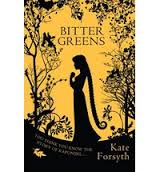
Bitter Greens

BitterGreens2

The reinventing of a classic fairytale is nothing new, it’s as old as the spoken word, but in recent years there has been a rush on this trend. To do this successfully the talent lies in making each story its own. The book and author who has done this with finesse and expertise is Bitter Green’s by Kate Forsyth.  In the reworking of the fable, Rapunzel, Forsyth has made a version that’s an intriguing blend of history and fairytale.

It is through Forsyth’s extensive research that we are transported to the court of the Sun King, Louis XIV in France where we follow Charlotte-Rose de la Force, one of the first writers of the story Rapunzel. Charlotte is banished to a convent for her scandalous behaviour. (Charlotte- Rose de la Force is such a fascinating person that everyone should follow this book with one of the biographies of her life). It is here that Charlotte meets a nun called Seraphina who tells her the tale of a young girl, with long red hair, named Margerita (Rapunzel) who is sold by her father to a Selena Leonelli for some bitter greens. Selena, also known as the La Strega Bella, is the muse for the renaissance artist Tiziano. Kate Forsyth’s writing is like delicate lacework  interweaving the stories of these women. Their lives are entwined through common threads of desire, love and obsession. We voyeuristically watch these characters through the hobbled streets of 16th century Venice and the grand palace of Versaille to the sparse convent of 17th century France. It is an intriguing journey of magic, tragedy, loss and consequences. Enjoy!

NB This book was published early last year, but with Kate’s soon to be released Dancing on Knives I thought I’d review her book, which is most dear to me.